Tribal Historic
PReservation Office

Seminole
SEMINOLE
1812
Patriot War invasion of Florida
Civilian militias comprised of US citizens from Georgia and Alabama, calling themselves the ‘Patriot Army,’ invaded Florida intending to seize it from the Spanish. The Seminole had been trading peacefully with Spain for over 30 years and allied with them to drive the American militias back north.
1812-1814
In Georgia, Muscogee towns allied with the United States formed the Creek Confederation, claiming to represent all Muscogee speaking peoples. The Seminole and the Upper Creek of Alabama refused to acknowledge their claims. When the Creek Confederacy tried to enforce control in Alabama, towns fought back. The people of these towns became known as “Red Sticks.” The Creek Confederacy called for aid from the US, who sent militia forces led by Andrew Jackson. Jackson drove the Upper Creek from their lands into Florida where they joined with the Seminole. Jackson then demanded the Creek Confederacy surrender most of their land to the United States.
July 27, 1816
Prospect Bluff Massacre
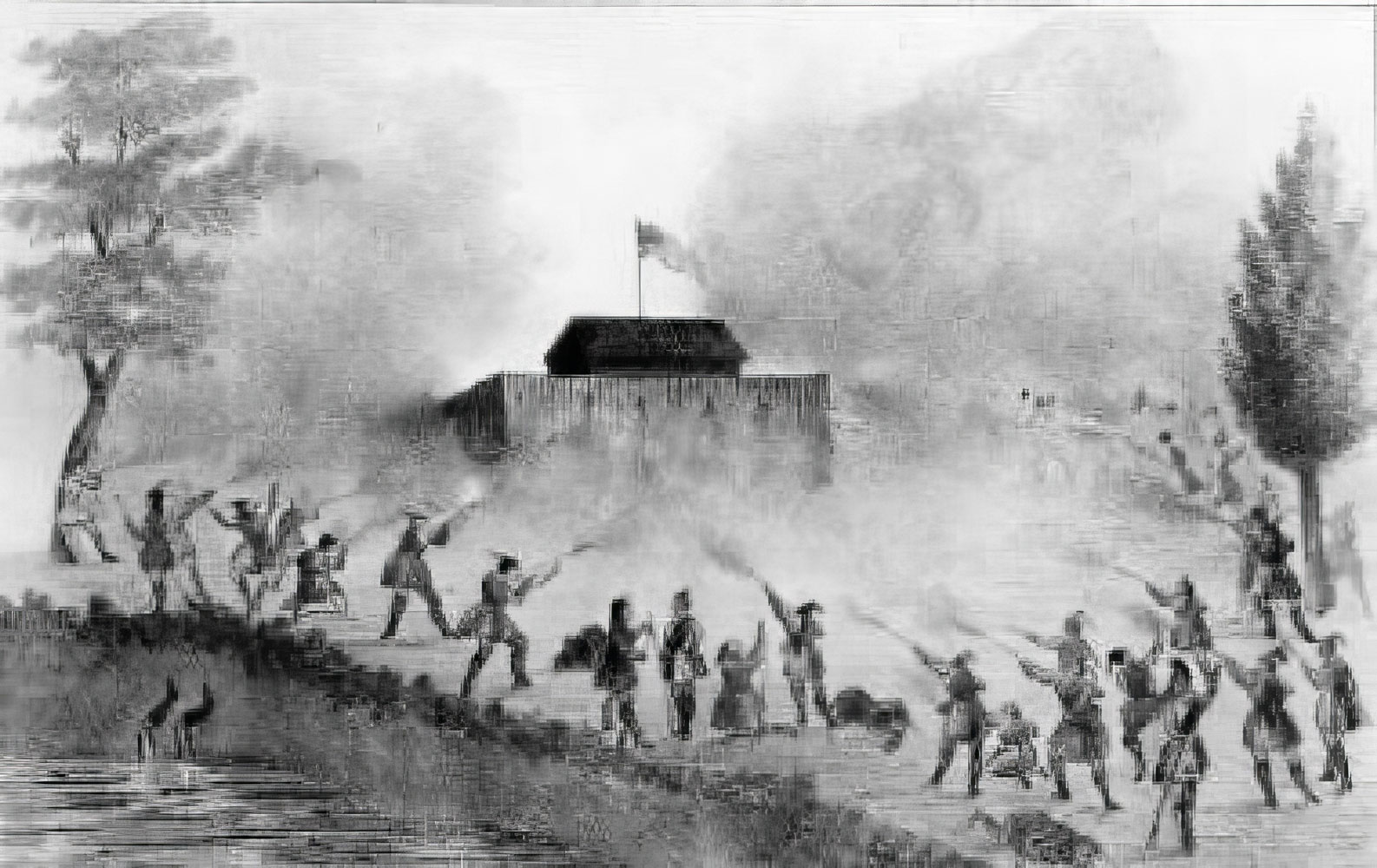
The US attacked a fort on Prospect Bluff--home to a free African community. African allies--many born free in Florida, others self-liberated from enslavement and recognized as free people under Spanish law--established towns in Florida and fought alongside Indigenous neighbors. A cannon shot hit the gunpowder magazine, triggering an explosion that destroyed the fort, killing over 300 men, women, and children.
Nov. 21, 1817
Attack on Fowltown
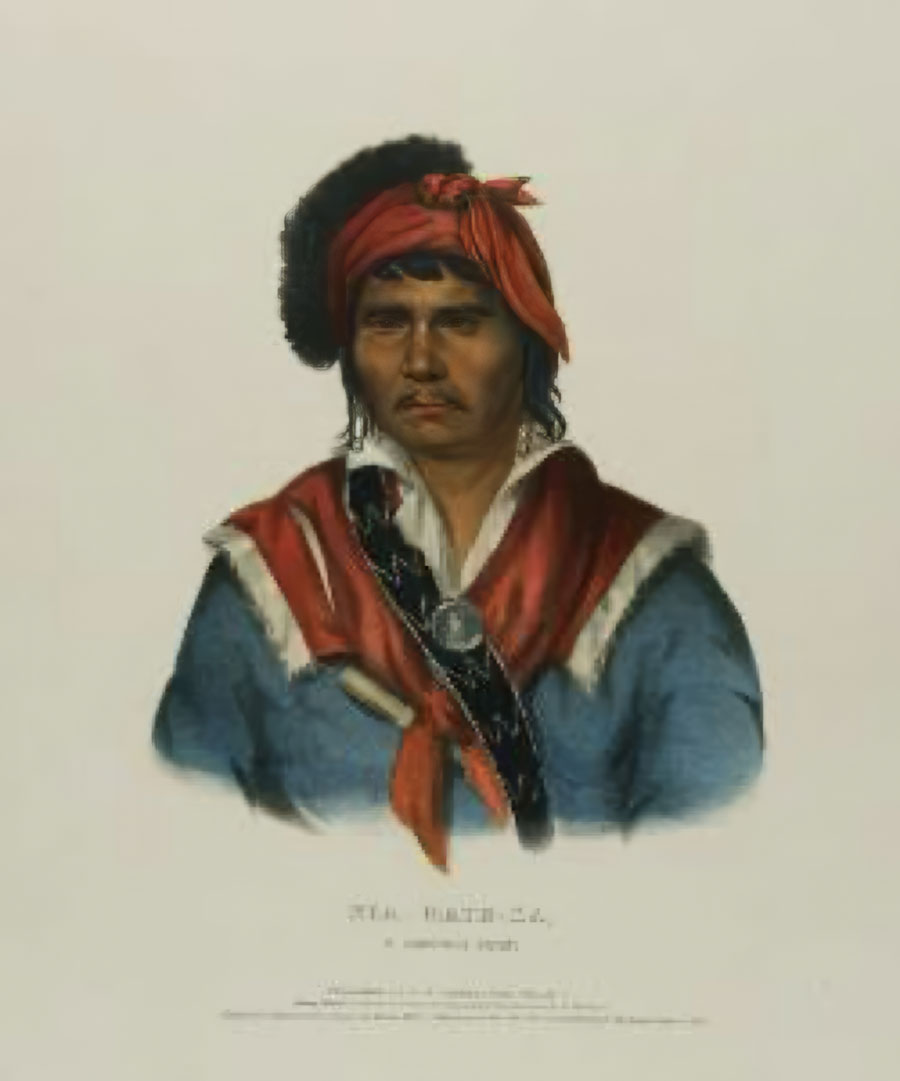
Under a treaty with the Creek Confederacy, General Edmund P. Gaines claimed land that belonged to the Indigenous village of Fowltown. The leader, Neamathla, refused, stating “we are not Creek.” Gaines’ forces attacked the town in retribution. While the first attack was repelled, Gaines soon returned with a larger force to take the land. He ordered the town and crops burnt, and cattle slaughtered or stolen.
Nov. 30, 1817
Scott Battle
Neamathla led a strike in retaliation for Fowltown. Knowing a boat of soldiers was traveling upriver, he and his warriors attacked, killing everyone on board. However, in addition to soldiers, the boat had been carrying civilian families. The US reported this as the “Scott Massacre,” and used the attack to create support for a war on the Seminole.
April 1818
Jackson’s Invasion
The United States sent military forces, again led by Andrew Jackson, with orders to strike against the Seminole towns. Jackson led his army into Florida, where they attacked three Seminole towns, killing the people and burning them down. He then seized the Spanish fort of San Marcos. His forces captured and executed Indigenous leaders, Hillis hadjo [Josiah Francis] and Hoemotchemucho, and executed two British traders who were Seminole allies, Alexander Arbuthnot and Robert Ambrister, after a mock trial.
1819
The Adams-Onís Treaty
Jackson’s army, against orders, occupied the Spanish town of Pensacola, creating an international incident between the US and Spain. The invasion resulted in the Adams-Onís Treaty, ceding Florida to the United States. Under the treaty all Spanish citizens, including the Indigenous people of Florida, were full citizens with personal and property rights. Despite this, the American army continued its attacks on Seminole and Free African towns, seizing the land and people to enslave.
1819-1921
War Continues
The American army pushed further into central Florida, attacking the towns of Bowlegs, a Seminole leader, and Nero, a Free African leader. Heavy losses forced them to move further south to evade US aggression. American settlers began moving into Florida, seizing cattle, and enslaving the Free African people they could capture.
Sept. 18, 1823
Treaty of Moultrie Creek
Seminole leaders met with American representatives at Moultrie Creek to negotiate an end to the war. The terms stipulated the Seminole would give up their lands in north Florida and move to a reservation in central Florida for twenty years, and mandated all trade be through the United States. In exchange the Seminole were promised peace, goods, and education. The new lands proved unsuitable, assistance never arrived, and White settlers continued to encroach on Seminole land.
April – June 1826
Negotiations
Representatives were sent to Washington D.C., and successfully negotiated with President John Quincy Adams and Congress to send the funds and support promised in the Treaty, as well as an extension of the northern border.
May 28, 1830
Indian Removal Act
Under President Andrew Jackson, Congress passed the Indian Removal Act of 1830. This act broke all standing treaties with Indigenous nations, including the Treaty of Moultrie Creek, and directed the forced removal of all Indigenous people to lands west of the Mississippi River.
May 9, 1832
Treaty of Payne’s Landing
The United States sent a delegation led by James Gadsden to try to forge a new treaty, one that would have the Seminole agree to leave Florida. Many of the US officers at the talks objected to Gadsden’s underhanded and misleading tactics. Seminole leaders agreed to survey the offered land, but Gadsden reported this instead as an agreement to leave. After surveying the land, Seminole representatives were imprisoned and forced to make their mark on the Treaty of Fort Gibson. The Seminole have never considered this treaty--signed under duress--to be valid.
1835
Wiley Thompson Appointed
Thompson, a friend of Andrew Jackson, was appointed Superintendent of Seminole Removal, with orders to achieve this end by any means necessary. Ignoring the complaints about the breaking of the Treaty of Moultrie Creek and the US deception at Payne’s Landing and Fort Gibson, Thompson insisted the Seminole people leave Florida. When they refused he responded with a letter from Jackson telling them to “leave or die.” With this knowledge, the Seminole began to prepare for war.
Dec. 28, 1835
Dade Battle and Thompson Assassination
The Army ordered a detachment of 108 soldiers sent to Fort King in preparation for strikes into Seminole land. The soldiers, led by Major Francis Dade, marched through Seminole lands. Alerted to the movement, Seminole leaders prepared an ambush. Micanopy fired the first shot, striking Dade dead. Only three US soldiers survived the encounter. In a coordinated act, Osceola led a smaller strike that killed Wiley Thompson just outside Fort King.
Feb. 1836
Gaines’ Battle of the Withlacoochee
Seminole forces intercept an army force under the command of General Edmund P. Gaines, pinning them down on the Withlacoochee River. After several days, and with Gaines receiving no reinforcements, the Seminole call a ceasefire and allow Gaines and his men to retreat.
Grey and James Lithograph courtesy Florida Memory Project RC05221
Feb. – April 1836
Scott’s Campaign
Major General Winfield Scott is given command of the Army of Florida, with orders to remove or exterminate the Seminole and their allies. The Seminole use their knowledge of the wetlands environment to evade capture and wage a defensive guerilla war. Not being properly prepared for the environment of Florida, army forces take heavy losses from disease and infection. Scott is soon removed from command.
Oct. 21, 1837
Capture of Osceola
Army soldiers under the command of General Thomas Jesup captured Emathla, a lead member of the Seminole War Council. His capture was used to lure his son Coacoochee (Wild Cat) and Osceola to negotiate under a flag of truce. When they arrived, Jesup ordered his men to surround and capture them. This violation of the rules of war by Jesup caused outrage in the US, where the war was increasingly unpopular.
Nov. 1837
Osceola and Coacoochee, along with their warriors and families, were imprisoned at Fort Marion (Castillo de San Marcos) in Saint Augustine. While there, Coacoochee and 28 warriors staged an escape from a locked cell. Osceola--too ill to take part--remained behind.
Dec. 25, 1837
Battle of Okeechobee
Seeking a decisive victory, General Zachary Taylor attacked Seminole forces north of Lake Okeechobee. Knowing he was approaching, the area was prepared for an ambush by sharpening the cypress knees below the water line and creating cover for Seminole marksmen. On arrival, Taylor sent his forces into the ambush, where Seminole forces kept them at bay so families and non-combatants could escape using readied canoes. Throughout the battle twelve Seminole were killed, and fourteen wounded. Taylor’s forces suffered 137 casualties, 25 of them fatal. Despite the heavy loss, Taylor reported the battle as a success to his superiors .
Jan. 30, 1838
Death of Osceola
Osceola was transferred to Fort Moultrie in South Carolina. Though still sick, he spoke with newspaper reporters, government officials, and artists hired to paint and draw his portrait. According to the doctor present, he passed away from malaria while held there. His belongings were taken as souvenirs by the officers, and his head was removed by the doctor for research and display.
May 19, 1839
Alexander Macomb’s Peace
With the War becoming increasingly unpopular, Congress sends Commanding General Alexander Macomb to Florida to negotiate a peace. Chitto Tustenuggee is sent to represent the War Council. They reached an agreement that would end hostilities if the Seminole remained south of the Peace River. As part of the agreement, the United States army built a military fort and trading post on the Caloosahatchee River. Macomb had intended the treaty to be temporary but presented it to the Seminole as permanent. A letter written by Macomb is widely published in American newspapers where he states the intention of the Treaty is to remove the Seminole “much sooner than can be done by force,” under the misconception the Seminole would not learn. When they do, a force is assembled to assault the camp along the Caloosahatchee and seize the goods from the post.
1840-1842
The war continues for several more years. Mutual distrust leads to the failure of all attempts at diplomacy. General Armistead forms large battalions to scour southern Florida with orders to capture or kill all Seminole, and to destroy their camps and crops wherever they find them. All Seminole, warriors and families alike, live under constant threat, needing to continuously move camps to evade patrols; . Armistead is replaced by Winfield Scott who is expected to find a diplomatic solution. Instead, Scott continues Armistead’s aggressive strategy.
August 14, 1842
Under political pressure, and despite no formal agreement or discussions with the Seminole taking place, General Scott declares the Seminole War to be over. Believing there to be a little more than two hundred Seminole in Florida, the army redirects its focus to guarding settlements.
1842
Florida Armed Occupation Act
To help with the war effort and to reduce the cost of lives and supplies lost to Florida, Congress passed the Armed Occupation Act of 1842. It promised 160 acres of land in northeastern Florida to White men willing to settle there. They are required to be armed, to homestead land at least two miles from the nearest military post, build a house, and live there for five years.
Oct. 1852
Seminole Delegation travels to Washington DC.
Holata Micco (Billy Bowlegs, Snake Clan) served as a spokesperson for the Seminole, dealing with US representatives, and became a friend to the appointed Indian Agent, Capt. John Casey. Bowlegs led a delegation to Washington, D.C. to call for an end to the War that would allow the Seminole to remain in Florida, during which he and our other leaders met with President Millard Filmore and members of Congress.
1855
Surveyors Sent onto Seminole Territory
Secretary of War Jefferson Davis began a pressure campaign on the Seminole, and ordered army surveyors into known Seminole territory and towns to openly assess the land for White habitation. In addition to these orders, they began looting and burning Seminole camps. The intention was to make occupation appear inevitable, prompting Tribal members to either leave or fight back. They found success when one survey team destroyed the camp where Billy Bowlegs lived. Bowlegs led a group of warriors in retaliation, killing most of the team. The US used this as justification to declare war once again.
1856
The Billy Bowlegs War
The Army had learned the lessons of the last decades, and changed their tactics. Troops were supplied with uniforms and equipment better suited to the Florida wetlands. Boats and rafts were used for movement where needed instead of wetland marches, and soldiers were not tasked with hunting down the Seminole warriors. Instead, the priority was placed on sieging Seminole camps and capturing noncombatants. Women, children, and elders were captured and held in concentration camps, first at Fort Myers and then at Egmont Key. Messengers were sent to find the warriors in the field to let them know their families were being held and would be sent to Oklahoma. If they wanted to be with their families, they had to surrender.
1858
After a lifetime of war, Billy Bowlegs and his followers agreed to removal, and went to Fort Myers. There they bordered a steamship named Gray Cloud. They were first taken to Egmont Key, where the families and warriors were reunited. The next day the Grey Cloud departed for New Orleans with all surviving prisoners. It was the last voyage of Indian Removal.
Despite the losses, several hundred Seminole remained in the Florida Wetlands. They moved deeper into the wetlands, remaining free and unconquered.